
DAOMS: Rethinking Trust in Blockchain Finance
DAOMS introduces a new approach to peer-to-peer finance by partnering blockchain transparency with escrow mechanisms, aiming to change how digital transactions are established and verified. This article unpacks DAOMS's vision, technology, and its potential to challenge the traditional barriers of trust in digital finance.
Blockchain technology is evolving at a remarkable pace. Beyond familiar digital assets such as Bitcoin and Ethereum, it is now inspiring new approaches to how we send money, buy goods, and transact with one another.
But this raises an important question:
“What is the point of advanced technology if we still cannot feel confident when trading with someone we do not know?”
One project exploring that very question is DAOMS.
DAOMS aims to combine blockchain-based transaction systems with the concept of escrow, creating a more structured environment for activities ranging from peer-to-peer transactions to digital asset exchanges.
Rather than focusing solely on buying and selling cryptocurrencies, the project seeks to bring transparency, convenience, and trust together throughout the transaction process, from initiation to completion.
So, what exactly is DAOMS trying to build, and what makes its approach worth watching?
Let’s take a closer look.
1. What Exactly Is DAOMS?
According to publicly released introductory materials, DAOMS.NET (DAOMS) is a platform designed to connect ordering, trading, settlement, and management functions within a blockchain-based transaction environment.
The platform was introduced alongside OMS (Open Money Stack), a service announced as having launched in August 2026.
The project was presented by developer Riyan Patel, who is described as having experience in on-chain data analytics and the design of blockchain transaction structures.
The materials also state that he worked on on-chain data projects with his older brother, Adit Patel.
The ideas highlighted in this development background go beyond transaction speed:
How transparently can a transaction process be verified?
How effectively can transaction records be tracked and managed?
Can a system create a more trustworthy environment even when participants do not know each other?
DAOMS can therefore be understood as a blockchain-based transaction infrastructure project built around these questions.
However, the available materials do not independently establish every detail of its legal corporate entity, financial licenses, or operational scope.
For that reason, describing DAOMS as a platform and service seeking to build a blockchain-based financial transaction environment is more precise than simply calling it a new regulated financial institution.
2. Why Does Trust Still Matter in Blockchain Transactions?
When we shop online, we naturally rely on a number of safeguards.
We check payment confirmations, track deliveries, and contact sellers or platforms when something goes wrong.
But the situation can be very different in a peer-to-peer, or P2P, environment where two people transact directly.
Imagine buying a digital product from someone overseas.
The buyer may hesitate to send money first, while the seller may be reluctant to deliver the product before receiving payment.
Neither party necessarily knows the other.
Similar concerns exist in blockchain transactions.
Although blockchain networks can provide accessible transaction records, the existence of a record does not, by itself, guarantee that the other party will fulfill their promise.
Assets sent to the wrong address may be difficult or impossible to recover. Disputes can also arise over whether agreed transaction conditions were met.
This is why the important question in digital finance goes beyond “Can a transaction take place?”
It becomes “How can we create a process that both parties can understand and trust?”
That is the issue DAOMS is attempting to address.
3. Understanding the Core Concept: OMS (Open Money Stack)
Within the DAOMS project, OMS stands for Open Money Stack.
It is the name the project uses for its concept of linking the various functions involved in moving money and digital assets.
In simple terms, the idea is to bring separate transaction steps into a more connected process:
Order placement → Review of transaction terms → Trade execution → Settlement → Transaction record management
Users often find financial services complicated when these steps are scattered across different platforms.
If they must place an order in one place, move assets somewhere else, and check records through another service, the likelihood of confusion or mistakes may increase.
DAOMS aims to handle these activities within a more consistent framework.
Of course, this does not mean that every feature is already fully supported or that all transactions are automatically processed.
The actual capabilities and technical mechanisms should be checked through the platform itself and its official documentation.
Still, the design goal of connecting the beginning and end of a transaction within one system is an interesting idea in its own right.
4. Escrow: One of the Most Notable Ideas Behind DAOMS
It is difficult to discuss DAOMS without mentioning escrow.
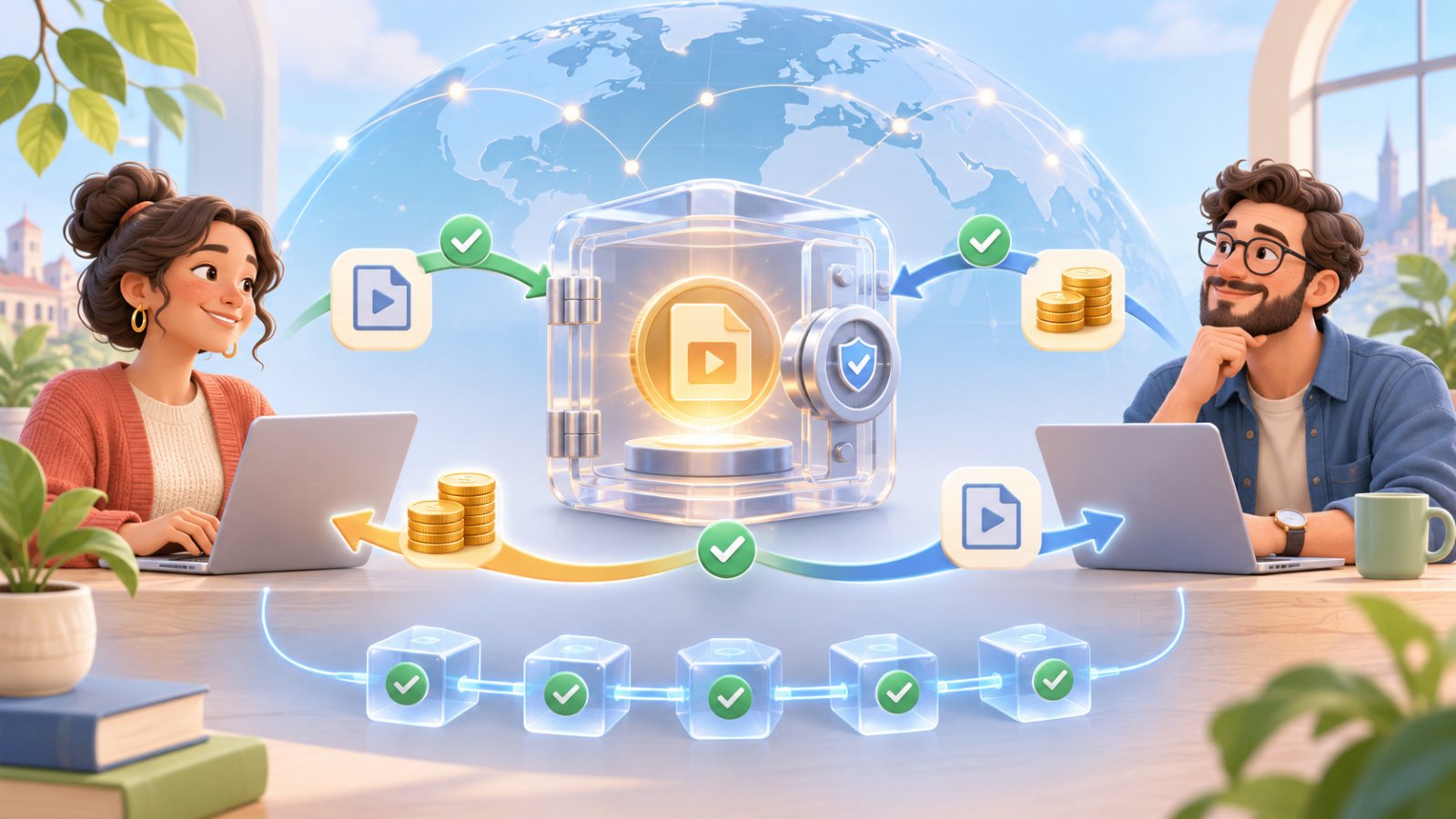
Escrow is an arrangement in which payment is held separately until agreed conditions are satisfied, after which the funds are released according to those terms.
The concept is already familiar in online commerce and many traditional financial transactions.
Consider a simple example in which Person A wants to buy a digital product from Person B:
Buyer A and Seller B agree on the transaction terms.
The payment is held under the agreed escrow arrangement.
Seller B delivers the promised product or service.
Once the predefined conditions are fulfilled, payment is released to the seller.
If a problem arises, the parties follow the dispute-resolution procedure established in advance.
This example explains how escrow works in general.
The exact custody arrangement, payment-release conditions, and dispute-resolution features implemented by DAOMS require separate verification.
Even so, the idea of incorporating escrow into blockchain transactions has a clear purpose.
A defined confirmation process may help reduce the anxiety that comes from having to send payment before knowing whether the other party will deliver.
DAOMS has described its combination of blockchain OMS and escrow as an attempt of a “world-first” caliber.
This is the project’s own characterization, not an independently verified claim that it is the first such system in the world.
5. Potential Advantage No. 1: A More Understandable Transaction Process
For a new financial service to become familiar to a broad audience, it must first be reasonably easy to use.
Traditional blockchain services can present unfamiliar concepts to newcomers: wallet addresses, network selection, transaction approvals, fees, and transaction hashes, to name a few.
When the functions needed to complete one transaction are distributed across several services, the learning curve becomes even steeper.
If DAOMS successfully delivers on its goal of integrating ordering, trading, settlement, and management, users may find it easier to understand the full transaction process.
This kind of structure could be particularly useful to people who frequently conduct P2P asset transactions or sellers who need to manage multiple settlement records.
The goal is not to explain complicated technology in even more complicated language, but to make the process itself simpler.
That is one of the first potential strengths worth examining.
6. Potential Advantage No. 2: Transparency and Traceability of Transaction Records
One of blockchain technology’s defining characteristics is that certain transaction records can be inspected on the network.
When transactions are recorded on-chain, information such as relevant addresses, transaction times, and asset movements may be viewed through a blockchain explorer.
These features can help participants verify specific parts of a transaction or compare records.
DAOMS’ emphasis on on-chain data is closely related to this possibility.
For example, if two parties disagree about what happened in a transaction, accessible records may help establish parts of the factual sequence.
Businesses may also benefit from the ability to organize transaction histories and settlement records more systematically.
However, a record appearing on a blockchain does not mean that every associated claim is accurate or that the real-world identity of the counterparty is known.
Off-chain events, such as the delivery of physical goods or completion of a service, may still require separate confirmation.
Understanding this distinction is essential when evaluating what DAOMS could realistically offer.
7. Potential Advantage No. 3: Another Option for P2P Transactions Between Strangers
P2P stands for peer-to-peer.
It generally refers to direct transactions between individuals or other participants.
The concept extends beyond familiar secondhand sales to digital content, online services, and transactions within online communities.
One attraction of P2P trading is that the parties can agree on their own terms.
The challenge is that they may know little about each other, and resolving problems can be difficult if a transaction does not go as planned.
If DAOMS’ escrow system provides clear payment-release conditions and reliable dispute procedures in practice, it could become one option for addressing these concerns.
The key point is not “Escrow makes every transaction completely safe,” but rather “Does the system offer a more structured and careful way to transact?”
To assess that benefit properly, users would need to know when funds can be withheld, who makes decisions, and how refunds are handled when a disagreement occurs.
8. Potential Advantage No. 4: Opportunities in Cross-Border Transactions and Digital Asset Exchange
Blockchain networks are designed to connect participants across national borders.
This makes them relevant to ongoing discussions about international digital commerce and settlement.
The potential applications mentioned in DAOMS-related materials include P2P trading, over-the-counter (OTC) transactions, digital asset exchanges, and global payments.
Consider an international freelancer completing a project for a client in another country.
Or imagine two people in different regions arranging an exchange of digital assets.
In both situations, the timing of payment and the confirmation process can be important.
If transaction record management and conditional settlement could be connected smoothly, such services might help reduce administrative burdens for participants.
These are illustrations of potential use cases, not confirmation that DAOMS currently supports every country, currency, asset, or transaction type mentioned.
Cross-border transfers and digital asset exchanges also involve different regulatory and anti-money-laundering requirements depending on the jurisdiction.
9. Potential Advantage No. 5: Integration With the OMWIX Wallet
DAOMS-related introductory materials also mention OMWIX, described as a decentralized wallet intended to improve user convenience.
In blockchain transactions, a wallet is a key starting point for managing assets and approving transfers.
A smoother connection between a wallet and a transaction platform could therefore make the user experience more convenient.
The idea of considering both the platform and the wallet together suggests several potential benefits:
A more connected experience between asset management and transactions
Greater convenience when approving transactions and reviewing records
Better accessibility for people who are new to blockchain services
However, OMWIX’s supported networks and assets, private-key management model, wallet recovery process, and security verification should all be checked in official technical documentation.
In particular, describing a wallet as decentralized does not, by itself, establish how private keys are held or guarantee the safety of funds.
10. Who Might Find DAOMS Interesting?
So, who might have reason to follow a project like DAOMS?
First, people who have experienced trust-related concerns in person-to-person transactions.
If payment conditions and verification procedures matter to them, the concept of blockchain-based escrow may be worth understanding.
Second, people who sell digital products or services.
Sellers of online content or services often need organized ways to monitor orders and keep track of settlement records.
Third, people who are interested in blockchain but find existing platforms difficult to use.
A service that attempts to simplify complex processes may be worth observing as its actual features are developed and tested.
Fourth, people studying Web3 and emerging financial infrastructure.
DAOMS offers a case study in applying blockchain concepts to transaction workflows and the practical challenge of creating trust between users.
Ultimately, the appeal of DAOMS should not rest on expectations of quick profits.
Its more meaningful question is whether it can make digital transactions easier to understand and more responsibly managed.
11. How Is This Different From Traditional Transaction Platforms?
In many conventional online transactions, a central platform plays a major role in payments, settlement, and dispute resolution.
Users operate within the rules set by that provider.
The model described by DAOMS, by contrast, seeks to combine blockchain records with escrow arrangements so that portions of the transaction process may be more readily verified and settlements may follow defined conditions.
But neither model is inherently better in every situation.
Traditional services may offer established consumer protections, customer support, and refund procedures.
Blockchain-based approaches may offer advantages in the verification of certain records and in connecting different systems.
What matters is not the technology’s name, but how effectively the service protects the people who use it.
For DAOMS to establish lasting competitiveness, it would need to demonstrate not only convenient functionality but also dependable responses to failed transactions and disputes.
12. What Should Users Check Before Trusting Any New Platform?
The direction DAOMS is pursuing is certainly interesting.
Even so, enthusiasm for a new financial service should always be accompanied by careful questions.
1. Is the operator clearly identified?
Users should look for information about the legal entity operating the service, its location, terms of use, and channels for questions or dispute submissions.
2. Where and how are assets held under the escrow arrangement?
It is important to understand who can access the funds, how release conditions are evaluated, and what happens if a transaction is canceled.
3. Is there evidence of independent security review?
Users should check whether smart contracts have been audited and whether external security assessments or incident-response policies are available.
4. Are fees and transaction conditions transparent?
Transaction fees, network fees, settlement times, and cancellation or refund conditions should be understood before using a service.
5. Does the service comply with the rules that apply to its users?
Depending on the actual activities provided, services involving the exchange, brokerage, or custody of virtual assets may be subject to different legal and reporting requirements.
Users in South Korea, for example, should check relevant financial regulatory information when considering services offered to them.
These questions are not reasons to dismiss DAOMS.
Rather, they are the basic criteria for judging whether a promising concept is becoming a service people can reasonably trust.
13. The Bigger Idea: Trustworthy Transactions Matter More Than Simply Fast Transactions
Whenever a new technology emerges, people often focus first on speed and the number of available features.
In finance and commerce, however, those things are not enough.
An amount of money that seems small to one person may be an important asset to someone else.
That is why clear procedures, fulfilled commitments, and reliable responses when problems arise are essential.
This helps explain why DAOMS discusses blockchain data and escrow together.
Its underlying idea is to connect technology that records transactions with procedures designed to help participants honor agreed terms.
If that concept is implemented reliably in a real service, it could become a meaningful option not only for experienced blockchain users but also for people who are less familiar with Web3.
At the same time, important challenges remain.
Technical security, transparent operations, dispute resolution, user protection, and compliance with different countries’ regulations all require attention before lasting trust can develop.
Perhaps the most constructive way to view DAOMS is neither with unconditional enthusiasm nor with a premature judgment, but with a willingness to understand what the project is trying to change and observe how well it delivers in practice.
Final Thoughts: Why DAOMS Is Worth Watching
Today, we explored what DAOMS is, what its blockchain-based transaction platform aims to achieve, and which features may offer potential advantages.
Its core ideas can be summarized in three points:
First, an integrated structure intended to connect ordering, trading, settlement, and management within one transaction flow.
Second, an escrow-based approach designed to help reduce trust-related friction between transaction participants.
Third, a focus on on-chain data and wallet integration that could bring blockchain transactions closer to everyday digital services.
The real reason to pay attention is not simply that the project uses blockchain technology.
It is whether the project can help solve the uncertainty and inconvenience people actually experience when making transactions.
It will be worth watching how DAOMS translates this vision into practical services and demonstrates reliable, transparent operations over time.
After all, the true value of technology is not found in impressive descriptions.
It is found in experiences that people can understand and use with confidence.
Found this helpful? Share it
Comments 0