
DAOMS: Building Trust into the System — A New P2P Finance Experience Powered by On-Chain Data and Escrow
DAOMS aims to create a trustworthy decentralized financial trading environment for everyone, built on on-chain data and escrow mechanisms. We explore the core principles behind its user-friendly design, which enables everyday consumers to participate easily, and examine how these principles are implemented in practice.
Exploring the Future of Decentralized Finance: DAOMS and Its Vision for a Trust-Centered Digital Financial Ecosystem
The global financial landscape is undergoing a remarkable transformation.
In the past, banks and traditional financial institutions served as the primary intermediaries for transferring money and conducting financial transactions. Today, blockchain technology is opening new possibilities by enabling individuals to exchange digital assets directly with one another.
At the center of this transformation are decentralized finance (DeFi) and Web3 technologies.
However, despite rapid technological advancements, significant challenges remain when it comes to accessibility and convenience for everyday consumers.
From setting up a blockchain wallet to managing digital assets and completing transactions, the process can often feel complicated and intimidating for first-time users.
Trust and security also remain major concerns, especially when conducting online transactions with unfamiliar individuals.
This is where DAOMS enters the conversation.
DAOMS envisions a decentralized financial environment that combines the transparency of on-chain data with escrow-based transaction mechanisms, making digital finance more accessible to everyday users.
Rather than focusing exclusively on sophisticated technology or experienced cryptocurrency traders, DAOMS emphasizes a broader vision: creating financial experiences that are transparent, accessible, and built around trust.
So, what exactly is DAOMS, what makes its approach different, and how could its vision contribute to the future of decentralized finance?
Let's explore its core principles, technological foundations, approach to P2P transactions, and long-term potential.
1. What Is DAOMS?
DAOMS is a Web3 financial platform that aims to establish a more trustworthy digital transaction environment through blockchain technology.
Its vision goes beyond simply enabling the exchange of digital assets.
Instead, DAOMS focuses on incorporating trust, transparency, and accessibility into the transaction process itself.
Traditional financial systems have generally relied on centralized institutions.
Banks, payment providers, and financial intermediaries facilitate transactions, safeguard assets, and establish trust between participants.
Blockchain-based decentralized finance introduces a different approach.
Through distributed networks and programmable systems, certain financial functions can be performed without depending entirely on conventional intermediaries.
DAOMS seeks to connect these technological possibilities with practical financial experiences for everyday consumers.
Its approach emphasizes reducing complexity, improving accessibility, and creating transaction environments where individuals can interact with greater confidence, even when they do not personally know one another.
The central idea behind DAOMS is not merely to develop technology for its own sake, but to make financial technology more useful and accessible to people.
2. Trust: The Core Value Behind DAOMS
What matters most when conducting financial transactions online?
Speed and affordability are certainly important.
However, one of the most fundamental considerations is trust.
Users want to know whether their assets will be transferred safely, whether the transaction will be completed properly, and what protections exist if something goes wrong.
These concerns become particularly important in peer-to-peer transactions.
Participants may be unfamiliar with one another, located in different countries, or operating through entirely digital channels.
Traditionally, third-party intermediaries have played an important role in reducing uncertainty.
DAOMS proposes a different perspective.
Rather than relying solely on personal trust between individuals, it aims to establish trust through technology, transparent transaction records, and predefined safeguards.
This concept can be described as system-based trust.
Instead of depending exclusively on promises or reputation, the transaction process can be supported by clearly established rules.
These rules may determine how assets are held, when they can be transferred, and how transaction records can be verified.
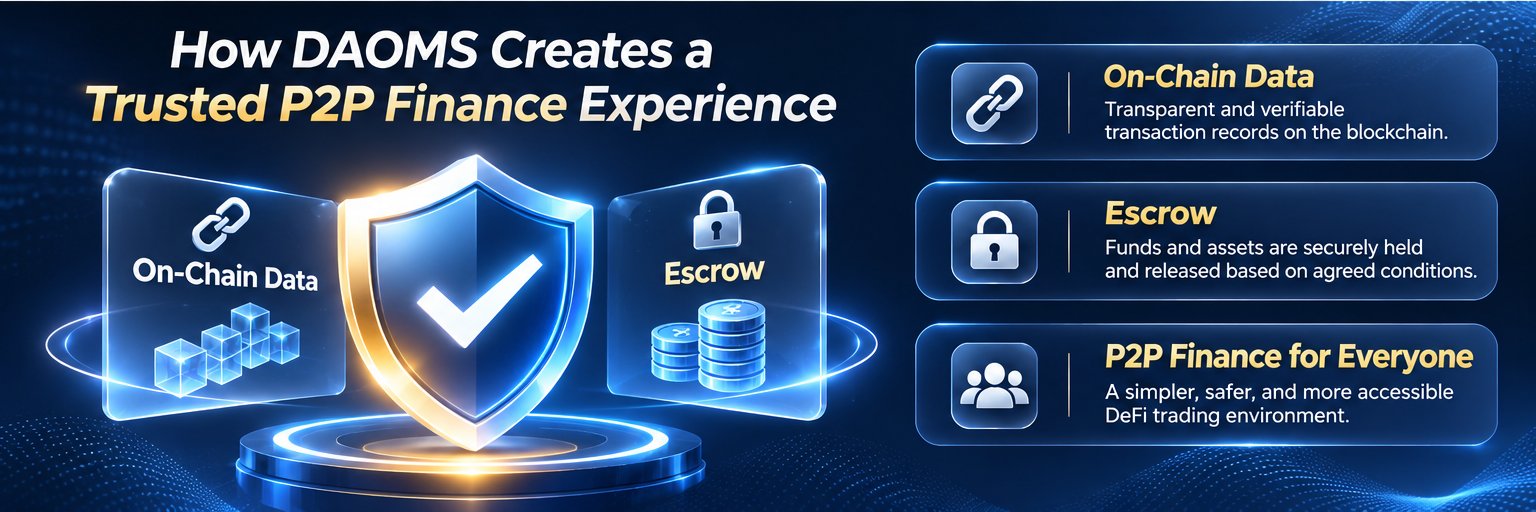
DAOMS highlights on-chain data and escrow mechanisms as important components of this approach.
Together, these technologies represent a potential foundation for a more transparent and trustworthy digital transaction environment.
3. Understanding On-Chain Data and Its Importance
To understand the technological direction of DAOMS, it is essential to explore the concept of on-chain data.
On-chain data refers to information recorded directly on a blockchain network.
For example, when digital assets are transferred from one blockchain wallet to another, the transaction can be recorded on the network.
On public blockchains, these records are generally accessible through blockchain explorers.
This allows users and other participants to examine transaction details and independently verify information recorded on the network.
Traditional centralized financial systems typically maintain transaction records within databases controlled by individual institutions.
Public blockchain networks, by contrast, are designed to allow distributed verification of recorded transactions.
This structure can improve transparency and make unauthorized alteration of confirmed records more difficult.
For example, users may be able to verify the movement of digital assets, transaction timestamps, and whether a blockchain transaction has been completed.
These capabilities can help reduce uncertainty and improve confidence in digital financial activities.
However, an important distinction must be made.
A transaction being recorded on a blockchain does not automatically guarantee that the person behind it is trustworthy or that every aspect of the underlying agreement is legitimate.
Nevertheless, on-chain records provide an important verification mechanism.
DAOMS aims to use these characteristics of blockchain technology to support greater transparency throughout the transaction process.
The ability to record, examine, and verify financial activity is an important foundation for building trust in digital finance.
4. Escrow: A Protective Mechanism for P2P Transactions
Another important component of the DAOMS vision is escrow.
Escrow is a mechanism in which funds or assets are held and released according to agreed-upon transaction conditions.
In simple terms, escrow provides a protective structure between buyers and sellers.
Imagine purchasing a product from someone you have never met.
If you send the payment first, there is a risk that the seller may fail to deliver the product.
On the other hand, if the seller delivers the product before receiving payment, the buyer may fail to pay.
Escrow mechanisms are designed to help reduce these risks.
In a conventional escrow transaction, funds may be held until the agreed-upon conditions have been satisfied.
Once the transaction requirements are fulfilled, the funds can be released to the appropriate party.
In a blockchain environment, escrow arrangements may also be supported by smart contracts.
A smart contract is a blockchain-based program designed to execute specific functions according to predefined conditions.
For example, a smart contract may be programmed to release digital assets once particular transaction requirements have been satisfied.
Such mechanisms can help reduce certain risks associated with transactions between unfamiliar parties.
However, the effectiveness of escrow depends on several factors, including how transaction conditions are verified, who controls the assets, and how disputes are resolved.
DAOMS emphasizes escrow as part of its broader vision for creating a more reliable P2P financial environment.
5. How Could a DAOMS-Style P2P Transaction Work?
P2P, or peer-to-peer, refers to a transaction model in which individuals interact directly with one another.
In digital finance, P2P structures can allow users to exchange assets without relying entirely on traditional financial intermediaries.
How might a transaction combining on-chain data and escrow mechanisms work?
The following example illustrates a general blockchain-based P2P escrow process.
Step 1: Establishing Transaction Terms
The buyer and seller agree on the transaction details, including the asset type, quantity, price, payment method, and applicable conditions.
Clear terms help establish a shared understanding before the transaction begins.
Step 2: Holding Assets Through Escrow
Depending on the transaction structure, the seller's digital assets or the buyer's payment may be placed into an escrow arrangement.
The assets remain subject to predefined release conditions.
Step 3: Completing the Agreed Transaction
Both parties proceed according to the established terms.
Certain conditions, such as payment confirmation or asset delivery, may need to be verified before the transaction can move forward.
Step 4: Releasing Assets and Completing the Transaction
Once the required conditions have been satisfied, the assets held through escrow may be released to the designated recipient.
If a dispute occurs, the applicable platform rules may require additional verification or a dispute-resolution process.
One of the main advantages of this type of structure is the ability to define clear conditions for asset transfers.
On-chain records may also provide visibility into blockchain-based asset movements.
This example describes a general blockchain escrow model and does not establish that DAOMS currently uses this exact implementation.
The specific transaction process offered by DAOMS would need to be confirmed through its official technical documentation and operational services.
6. How DAOMS Aims to Differentiate Itself from Traditional Web3 Platforms
The Web3 ecosystem has experienced considerable technological development.
However, accessibility remains an important challenge.
Many early blockchain services were designed primarily for developers, experienced investors, and users already familiar with digital assets.
For newcomers, even basic activities can require learning unfamiliar concepts.
Users may need to create wallets, connect to networks, understand transaction fees, and interact with smart contracts.
The possibility of making an irreversible transaction error can create additional concerns.
These barriers may discourage everyday consumers from exploring decentralized financial services.
DAOMS seeks to address this challenge by emphasizing a more user-centered approach.
Its underlying philosophy focuses not only on the capabilities of blockchain technology but also on how easily individuals can use those capabilities.
The goal is to move beyond technology-driven complexity toward a more accessible financial experience.
If decentralized financial services can combine straightforward transaction processes with transparent records and appropriate safeguards, they may become more approachable to a broader audience.
However, the actual competitiveness of DAOMS will depend on its implemented features, security measures, and real-world user experience.
7. Why the DAOMS Vision Matters for Everyday Consumers
For decentralized finance to achieve broader adoption, it must become accessible beyond communities of blockchain specialists and experienced traders.
Consider a consumer who wants to exchange digital assets with someone in another country.
The individual may not have extensive technical knowledge.
They may simply want a transaction process that is understandable, efficient, and supported by clear rules.
In this situation, transparency and transaction safeguards become especially valuable.
On-chain records can provide a means of verifying blockchain activity.
Escrow arrangements can establish conditions governing when assets are transferred.
Together, these features may help reduce certain uncertainties associated with P2P transactions.
DAOMS places emphasis on this consumer perspective.
Its vision suggests that users should not necessarily need to understand every technical component of blockchain infrastructure before benefiting from it.
Instead, technology should support a simpler and more accessible financial experience.
This represents an approach focused on practical usability rather than technological sophistication alone.
8. Riyan Patel and the Vision Behind DAOMS
According to the information presented about DAOMS, Riyan Patel has emphasized expanding access to decentralized finance as a central objective.
The broader vision is to move beyond a Web3 ecosystem primarily designed for developers, sophisticated investors, and high-risk digital asset traders.
Instead, the goal is to make decentralized financial transactions more approachable for ordinary consumers.
This reflects the idea that financial innovation should serve a wider audience.
While blockchain technology introduces new possibilities, accessibility and ease of use remain essential for broader adoption.
DAOMS seeks to bring these principles together.
Its proposed direction combines the transparency of blockchain with transaction mechanisms designed to reduce uncertainty.
The emphasis is not simply on digitizing financial transactions.
It is also on incorporating trust into the underlying structure of the transaction process.
This raises an important question for the future of decentralized finance:
How can advanced financial technology become useful to people who are not technology specialists?
If blockchain-based services can reduce complexity while maintaining appropriate safeguards, more consumers may have opportunities to participate in digital finance.
This is the broader transformation that DAOMS aims to support.
9. How Smart Contracts Could Transform Financial Transactions
Smart contracts play an important role in blockchain-based financial applications.
In traditional financial transactions, several administrative and intermediary processes may be required to verify conditions and facilitate asset transfers.
Smart contracts can automate certain functions according to predefined programmatic rules.
For example, a smart contract can be designed to release assets when specified conditions have been met.
Alternatively, it may restrict certain actions until the necessary requirements are satisfied.
These features can introduce consistency and programmability into transaction processes.
However, smart contracts are not a universal solution to every transaction-related problem.
External events, such as whether physical goods have been delivered or whether an off-chain payment has been completed, may require additional verification mechanisms.
Furthermore, programming errors and security vulnerabilities can create financial risks.
For this reason, smart contract security, independent audits, and responsible system design are important considerations.
The trust-centered financial model envisioned by DAOMS would similarly need to demonstrate technical reliability and appropriate security standards.
10. Essential Requirements for a Trustworthy Financial Platform
For the vision behind DAOMS to translate into a reliable financial service, several fundamental requirements must be addressed.
Transparency
Users should be able to understand the transaction process and verify relevant information.
Clear records can help improve accountability and reduce uncertainty.
Asset Protection
Escrow arrangements should clearly establish how assets are held, who controls them, and under which conditions they can be released or returned.
These rules are important for protecting participants.
Security
Blockchain services may face risks involving smart contract vulnerabilities, wallet security, unauthorized access, and user errors.
Independent security assessments and ongoing technical maintenance are therefore essential.
User Protection and Dispute Resolution
Even well-designed systems may encounter unexpected situations.
Users need clear procedures for reporting problems, resolving disputes, and understanding their available protections.
Regulatory Compliance
Financial regulations vary depending on jurisdiction, service structure, and transaction type.
A sustainable financial platform must consider its applicable legal and regulatory obligations.
These factors are essential to evaluating whether a trust-centered financial vision can be translated into a dependable real-world service.
11. DAOMS and the Mainstream Adoption of Web3 Finance
In the early development of the blockchain industry, much of the attention focused on technological innovation.
New networks, digital assets, decentralized applications, and financial protocols demonstrated the possibilities of distributed systems.
As the industry evolves, practical usability is becoming increasingly important.
A technology's long-term value depends not only on what it can accomplish but also on how effectively people can use it.
For Web3 finance to become more widely adopted, platforms must address everyday consumer expectations.
These include simplicity, transparency, reliability, and understandable transaction procedures.
DAOMS aligns its proposed approach with these priorities.
Rather than viewing blockchain integration as the final objective, it places emphasis on the improvements that blockchain technology may bring to the user experience.
This is particularly relevant in P2P finance, where confidence in the transaction process can influence whether users are willing to participate.
If on-chain verification and escrow mechanisms can provide meaningful improvements in transaction transparency and protection, they may contribute to more practical decentralized financial services.
However, sustained adoption would also depend on real-world performance, user satisfaction, regulatory considerations, and operational stability.
12. What Will Define DAOMS' Future Competitiveness?
A compelling vision is an important starting point for any emerging financial platform.
However, long-term competitiveness depends on practical execution.
Several areas will be particularly important in evaluating DAOMS' future development.
First, accessibility.
Can ordinary consumers use the platform without extensive blockchain knowledge?
Second, technical implementation.
How are on-chain data and escrow mechanisms integrated into actual transactions?
Third, security and reliability.
Does the platform provide transparent security information, clear asset-management rules, and appropriate dispute-resolution processes?
Fourth, user experience.
Can the technology deliver measurable improvements in convenience and transaction clarity?
Fifth, operational sustainability.
Can the service maintain reliable operations while meeting relevant consumer protection and regulatory requirements?
Progress in these areas would help demonstrate whether DAOMS can translate its vision into meaningful value for users.
Ultimately, success in digital finance requires more than innovative technology.
It requires delivering practical benefits that consumers can understand, trust, and consistently use.
13. The Future of Finance Through the DAOMS Perspective
The financial industry is likely to continue evolving toward increasingly digital and interconnected services.
Consumers are becoming accustomed to convenient financial experiences, clear transaction information, and efficient access to digital products.
At the same time, concerns regarding transparency, asset security, and financial accountability remain important.
Blockchain technology offers tools that may help address some of these challenges.
On-chain data can support transparent recordkeeping.
Smart contracts can enable programmable transaction conditions.
Escrow mechanisms can provide structured arrangements for holding and transferring assets.
DAOMS seeks to bring these concepts together within a financial environment focused on accessibility and trust.
One of the most significant ideas behind this vision is that trust should not depend solely on promises.
Instead, it should be supported by transparent processes, clearly defined rules, responsible operations, and reliable technology.
Trust in financial services is not established overnight.
It develops through consistent performance, transparency, effective safeguards, and positive user experiences.
The future of DAOMS will therefore depend on how successfully it can demonstrate these qualities in practice.
Conclusion: DAOMS and the Next Chapter of Decentralized Finance
The financial world is entering an era in which blockchain technology may play an increasingly important role in how digital assets are exchanged and managed.
Yet the future of decentralized finance will not be determined by technological advancement alone.
Accessibility, transparency, trust, and user protection will also be essential.
DAOMS presents a vision built around these priorities.
By emphasizing on-chain data and escrow-based transaction structures, it seeks to promote a financial environment where individuals can participate with greater clarity and confidence.
Its broader ambition can be summarized in one statement:
"Making complex financial technology more accessible while building trust directly into the transaction system."
This vision extends beyond the creation of another digital financial platform.
It reflects the growing importance of making decentralized finance practical for a broader range of consumers.
On-chain data can offer a foundation for transaction verification.
Escrow structures can help establish clear conditions for asset transfers.
User-centered design can make advanced technologies easier to navigate.
Together, these elements have the potential to contribute to a more accessible digital financial experience.
Of course, the extent to which DAOMS has implemented these capabilities, along with their effectiveness and security, requires independent verification.
Nevertheless, the principles emphasized by DAOMS highlight important challenges and opportunities for the broader Web3 financial industry.
The next generation of financial innovation may not simply be about creating more sophisticated technology.
It may be about making that technology easier to understand, more transparent, and more useful in everyday life.
DAOMS represents a vision of decentralized finance where technology supports accessibility and trust is built into the system.
As the digital financial ecosystem continues to evolve, it will be worth observing how DAOMS develops its services and works toward turning this vision into reality.
Found this helpful? Share it
Comments 0